Wednesday, August 26, 2009
Hogan's swing plane - misunderstood
I watch in amazement commentators and golf instructors talking about swing plane. Ben Hogan coined the term when he came up with the thought of his head sticking out from a huge pane of glass resting on his shoulders with the front edge lying just past the ball. He knew if he were to hit from the inside he had to keep his clubhead below the glass from the top of the swing through to the finish. I have seen several teaching aids trying to mimick the pane of glass either commercially made or homemade. What is never addressed is that Hogan's pane of glass also had to be moved during the down swing. The glass has to tip to the right of the target line and point to the right in the direction of the second baseman if you were standing at home plate or to about 10 o'clock if you were standing on 6 o'clock and ball was sitting in the center of the clock face. Hogan swung out from 4 o'clock to 10 o'clock hitting the inside quarter of the ball. See page 88 in Hogan's five lessons. That 4 to 10 motion is the only swing plane that matters. If you stand with your hands hanging at your side and start walking you will notice that your arms swing naturally as you walk. I lost that natural swing in my right arm after having a massive stroke in 2003. When I taught myself to play again with these paralysis limitations I literally have to force myself to create that "natural" arm swing for my right side. It dawned on me that this arm swing was the guide Hogan was using for swing plane. You can see it in his waggle before each shot. John Schlee, Hogan's only pupil, taught me years ago Hogan's actual secret. After understanding the arm swing and plane, I just had to get my hands in Hogan's "secret" position (not so secret since my book and DVD came out) to hit the ball purely. Works like a charm.


Monday, April 6, 2009
Tempo
I'd have say that Fred Couples has the best tempo of any pro golfer I've had the pleasure of watching. He uses Mother Nature better than anyone. He takes the club back outside raising his arms up high over his right shoulder and simply lets his arms drop in behind his right hip letting the club head fly from the inside out up to a relaxed effortlessly looking finish.
I met Fred's mom back in '92 after he had won the Masters along with Jim Nantz' dad. We had been following Fred at the Shark Shootout and had a wonderful day. I remember asking Fred's mom how proud she must be to have such a good looking and talented young man for a son. She smiled and said, "Oh, he's a dead-ringer for his father." We parted company and later after the round was finished I ran into her again at the practice tee. Fred had just finished hitting balls and told his mom to "Get dad, let's get something to eat." She went over to a group who had been watching Butch Harmon putting on a trick shot show. She came back with dad in tow and I was pleased to see that Fred was a "dead-ringer" for his dad. I told Fred's mom and she shook her head "No" and said "Oh he's not his father. This is his step father!" I was shocked and then she grabbed me and laughed. "I was kidding!!" She smiled and the were off to dinner. It wasn't too long after that Mrs. Couples passed away. She was a genuine class act with a great sense of humor.
I met Fred's mom back in '92 after he had won the Masters along with Jim Nantz' dad. We had been following Fred at the Shark Shootout and had a wonderful day. I remember asking Fred's mom how proud she must be to have such a good looking and talented young man for a son. She smiled and said, "Oh, he's a dead-ringer for his father." We parted company and later after the round was finished I ran into her again at the practice tee. Fred had just finished hitting balls and told his mom to "Get dad, let's get something to eat." She went over to a group who had been watching Butch Harmon putting on a trick shot show. She came back with dad in tow and I was pleased to see that Fred was a "dead-ringer" for his dad. I told Fred's mom and she shook her head "No" and said "Oh he's not his father. This is his step father!" I was shocked and then she grabbed me and laughed. "I was kidding!!" She smiled and the were off to dinner. It wasn't too long after that Mrs. Couples passed away. She was a genuine class act with a great sense of humor.
Saturday, February 28, 2009
Angular Momentum to the max
Jack Hamm, famous long drive champion and creator of "The Hammer", manages to maximize conservation of angular momentum beyond anyone I have witnessed in the thousands of hours of instruction video, competition video and my own up close and personal observations of some of the world's longest hitters. Hamm's approach comes right out of the science classroom as he was an engineering student at the same undergrad school I attended at the same time. I never met him or for that matter had any idea he was also a student there. His setup is simple. His take away is even more simple merely taking the club head away slowly turning the face and the back of his left hand parallel to the target line with his hand facing away from him when the club head is a knee height. He then simply picks the club up while turning his right shoulder as far away from the target as possible. His first move is a hard turn of his hips dropping his hands to his hip while the club head is still completely behind him. He turns as hard as he can and this ice skater spin catapults the club head through the hitting area as fast as he can allow it without throwing himself out of balance. It is a simple move to learn and can produce "POW!" big time for those looking to kill the ball. I wouldn't recommend it for your short game, hehe.
Mike
Mike
Saturday, February 21, 2009
Winning Thinking
In 2003 I was diagnosed with terminal cancer and then had a massive stroke landing me in an end of life hospice program in a nursing home. I was indeed left for dead. In January 2004 my lucidity returned but I was still terminal. I resolved to be happy no matter what and low and behold my health started improving. Not just improving but IMPROVING! to the extent that my cancer cleared up (no treatment) and I was able to learn to walk, talk, read, write, yes everything from scratch. I wrote my book, Winning Thinking, how to be happy almost all of the time, highlight all of the thinking techniques I use to keep myself happy and thereby maximizing the law of attraction bringing more happiness and abundance into my life. These techniques will teach you how to get yourself into the zone at will. I kept it short and to the point. If you're struggling with your golf game, business, relationships or just life in general these techniques will give you to power to take 100% control over your thinking and your life. It bloody works. Find the book at www.winningthinking.mikecortson.com You will be happy you did.
Also be sure to check you my radio broadcasts on positive thinking and the law of attraction. Great info and great guests including Australian Hall of Fame golf star Bruce Crampton. Learn how to think and win 7 times in one season just like Bruce! www.mikecortson.com Click the podcast download link and find all of my shows for FREE mp3 download. Listen, learn and enjoy!
Mike
Also be sure to check you my radio broadcasts on positive thinking and the law of attraction. Great info and great guests including Australian Hall of Fame golf star Bruce Crampton. Learn how to think and win 7 times in one season just like Bruce! www.mikecortson.com Click the podcast download link and find all of my shows for FREE mp3 download. Listen, learn and enjoy!
Mike
Tuesday, December 16, 2008
Pure Ball Striking
Ben Hogan was noted for his pure ball striking. John Schlee was his only pupil and I was fortunate enough to have learned Hogan's "secret" from him. Hogan made no mention of any "secret" in his 1957 book The Modern Fundamentals, Five Lessons. He did allude to it. A lawyer by trade, I have the skill to research analyze after decades of practicing being editor of law review back in law school. My golf library is bulging with books and videos from every era, expert and great player. I was a PGA Tour player manager for Australian Hall of Famer Bruce Crampton and others for many years. As a result, I had the good fortune to have been able to observe up close and personally the golf swings of the world's greatest players. Swings on tour are as varied as there are players. Many of the new comers have what we refer to as "cookie cutter swings" all based on modern teaching as expounded by a small circle of teachers brought to prominence through television, books and other media.
The modern swing is designed around positions believed if mastered in sequence will produce a "perfect" golf swing. Having studied these methods for decades now and seeing how frustrating and haphazard the results have been, especially in competition, I chose to revert to my own experiences as advocated by Hogan through Schlee to me.
Of note is that little in modern instruction focuses on the actual impact with the ball. All of the teachings are focused on the mechanics of swinging as if impact with the ball was merely a consequence of these mechanics. Hogan specified mechanics there can be no doubt, however, impact and trajectory were his primary focus. In teaching Schlee, Hogan asked John to show him his impact position. John got into the position he thought he should be in at impact and Hogan shook his head in disgust. Hogan adjusted John's impact position to the powerful position Hogan achieved as witnessed in stop action photos of himself and told John to start his swing from that position; swing back and through allowing himself to replicate the impact position on through to the finish. John did that and hit the ball pure and straight. Not to leave this welcome result to being a fluke, John repeated this swing each time starting from the position Hogan put him in for impact and low and behold John hit each shot perfectly.
By starting from this impact address position it became almost automatic for the body to return to that position from the back swing as if the body wanted to get right back to the impact position. The typical static address position with the club face square to the target is obviously not the impact position. At impact there is an enormous weight shift to the left side with the hips opened to the target slightly with the hands handle leading the club head. If the club face were left in its original address position is would be wide open at impact unless it were somehow closed by the hands. So the radial axis of the club head has to be achieved in some manner. This is where Hogan found his "secret".
In the 1955 Life magazine article, and I do have an original copy, Hogan explained about half of his "secret" indicating the "cupped left wrist" at the top of the back swing. In Five Lessons Hogan makes no mention of this. He actually talks about the left wrist "supinating". That term was misused there and continues to be misused by the top teachers I have studied. While the terminology is misused I fully understand what Hogan was talking about from my work with Schlee and my verification of it from strict scrutiny of hours of Hogan footage that I have. It required me to become intimately familiar with video editing software and I have become somewhat of an expert in using this tool to find that proverbial needle in the golf swing haystack. And I was immediately able to substantiate the "secret" because I knew what I was looking for in those films. I reviewed Jim McLean's video done with The Golf Channel on Hogan and it was abundantly clear that while Jim has a huge amount of understanding he did not understand what Hogan was doing. Nor have I witnessed any other teacher who has pointed to the features that Hogan so cleverly disguised. Just like a magic trick, Hogan's misdirection sent everyone on a wild goose chase.
The "cupped left wrist" at the top is actually a disguise. That opening of the club face made Hogan look about like all of his contemporaries at the top. In Five Lessons he said he wished that he had three right hands which is also a red herring. Close observation will show how Hogan closed the club face and the path upon which he determined to be crucial. At page 88 of Five Lessons he shows how the pane of glass had to move to accommodate the down swing plane. It is crucial. Also crucial is the weak left hand grip because it is that left hand and wrist that apply the fire to the swing. To understand this imagine that the club handle is a screw driver. To tighten a screw you would turn the handle clockwise. That would be the motion on the back swing which would open the club face as shown by a cupped left wrist at the top of the back swing. So it is logical that since the club was twisted in a clockwise manner on the back swing it would have to be twisted in a counter-clockwise manner on the down swing in order for the face to be square at impact. Right here is The "secret". This counter-clockwise twist his started right from the top of the back swing down and through as hard and fast as it can be done. Since the grip was weak from the outset the worst one can do is square the club face at the moment of impact.
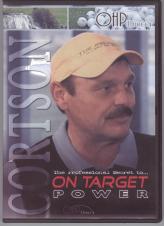
The launch sequence as I refer to it in my DVD "On Target Power" as it was shown to me by Schlee is; 1. knees, 2. hands, 3. club head. The left hand is aggressively twisting the handle through impact applying maximum speed all started from the ground up. It is far easier to demonstrate this in my video than to try and explain it here. The DVD can be seen at my web site, http://mikecortson.com/ or directly purchased at http://benhogan.ws/ .
Even in my state of disability and age I still maintain a 2 handicap actually handicapped. Hogan's technique is easy to learn and works like a charm.
Hit 'em straight.
Mike
mike@mikecortson.com
lessons year round call: (269) 326-0736
The modern swing is designed around positions believed if mastered in sequence will produce a "perfect" golf swing. Having studied these methods for decades now and seeing how frustrating and haphazard the results have been, especially in competition, I chose to revert to my own experiences as advocated by Hogan through Schlee to me.
Of note is that little in modern instruction focuses on the actual impact with the ball. All of the teachings are focused on the mechanics of swinging as if impact with the ball was merely a consequence of these mechanics. Hogan specified mechanics there can be no doubt, however, impact and trajectory were his primary focus. In teaching Schlee, Hogan asked John to show him his impact position. John got into the position he thought he should be in at impact and Hogan shook his head in disgust. Hogan adjusted John's impact position to the powerful position Hogan achieved as witnessed in stop action photos of himself and told John to start his swing from that position; swing back and through allowing himself to replicate the impact position on through to the finish. John did that and hit the ball pure and straight. Not to leave this welcome result to being a fluke, John repeated this swing each time starting from the position Hogan put him in for impact and low and behold John hit each shot perfectly.
By starting from this impact address position it became almost automatic for the body to return to that position from the back swing as if the body wanted to get right back to the impact position. The typical static address position with the club face square to the target is obviously not the impact position. At impact there is an enormous weight shift to the left side with the hips opened to the target slightly with the hands handle leading the club head. If the club face were left in its original address position is would be wide open at impact unless it were somehow closed by the hands. So the radial axis of the club head has to be achieved in some manner. This is where Hogan found his "secret".
In the 1955 Life magazine article, and I do have an original copy, Hogan explained about half of his "secret" indicating the "cupped left wrist" at the top of the back swing. In Five Lessons Hogan makes no mention of this. He actually talks about the left wrist "supinating". That term was misused there and continues to be misused by the top teachers I have studied. While the terminology is misused I fully understand what Hogan was talking about from my work with Schlee and my verification of it from strict scrutiny of hours of Hogan footage that I have. It required me to become intimately familiar with video editing software and I have become somewhat of an expert in using this tool to find that proverbial needle in the golf swing haystack. And I was immediately able to substantiate the "secret" because I knew what I was looking for in those films. I reviewed Jim McLean's video done with The Golf Channel on Hogan and it was abundantly clear that while Jim has a huge amount of understanding he did not understand what Hogan was doing. Nor have I witnessed any other teacher who has pointed to the features that Hogan so cleverly disguised. Just like a magic trick, Hogan's misdirection sent everyone on a wild goose chase.
The "cupped left wrist" at the top is actually a disguise. That opening of the club face made Hogan look about like all of his contemporaries at the top. In Five Lessons he said he wished that he had three right hands which is also a red herring. Close observation will show how Hogan closed the club face and the path upon which he determined to be crucial. At page 88 of Five Lessons he shows how the pane of glass had to move to accommodate the down swing plane. It is crucial. Also crucial is the weak left hand grip because it is that left hand and wrist that apply the fire to the swing. To understand this imagine that the club handle is a screw driver. To tighten a screw you would turn the handle clockwise. That would be the motion on the back swing which would open the club face as shown by a cupped left wrist at the top of the back swing. So it is logical that since the club was twisted in a clockwise manner on the back swing it would have to be twisted in a counter-clockwise manner on the down swing in order for the face to be square at impact. Right here is The "secret". This counter-clockwise twist his started right from the top of the back swing down and through as hard and fast as it can be done. Since the grip was weak from the outset the worst one can do is square the club face at the moment of impact.
The launch sequence as I refer to it in my DVD "On Target Power" as it was shown to me by Schlee is; 1. knees, 2. hands, 3. club head. The left hand is aggressively twisting the handle through impact applying maximum speed all started from the ground up. It is far easier to demonstrate this in my video than to try and explain it here. The DVD can be seen at my web site, http://mikecortson.com/ or directly purchased at http://benhogan.ws/ .
Even in my state of disability and age I still maintain a 2 handicap actually handicapped. Hogan's technique is easy to learn and works like a charm.
Hit 'em straight.
Mike
mike@mikecortson.com
lessons year round call: (269) 326-0736
Monday, November 24, 2008
Story
Oh Little One
By Michael Cortson
Having had the misfortune or fortune, depending on your point of view, of surviving a collision with most certain death, my observations of even the most basic of good and evil, right and wrong, and all of the core values upon which we all place our foundational beliefs were, to say the very least, violently shaken to rubble only to be rebuilt to a new and enlightened view. When I look back to a time when I was little and the world was filled with every possibility, dream and fantasy one could imagine, I see clearly now just how, at a glacier’s pace, my life evolved into a morass of confusion, fear and pain. Not that I was ever mindful that these most unwanted aspects were to be afoot, but how these virtues of success, safety and security were never more than a belief and illusion in the first place. That is to say that all the while that I studied and worked tirelessly to build a life, wealth and a family somewhere along the way that little person who I had been became lost and forgotten and thrown into the dust bin mostly likely never to be seen again. Perhaps it was the adult thing to do. I was to put aside childish thoughts and virtues and become a man taking the world head on without regard for anything more than my success, wealth and family. So there I was battering away day after day, month by month, year after year climbing some imaginary mountain to nowhere which at its peak there was to be some glorious reward.
Well, this journey came to an abrupt halt and I landed smack in the middle of the absolute end of it all staring helplessly at a ceiling which was to be my final view of all this. Frightening, wouldn’t you say, but of course. The end of it all is not something we wish to ponder at any length and that is due to our absolute fear of all fears, certain death and the unknown of it all. I look back now, having lost all that what was once so dear to me that I would tear the eyes from someone’s skull should they threaten my success, wealth and especially family. After all, I had devoted a lifetime to building these things and woe is to the one who dared threaten any of it!
So the little boy, that fragile harmless lad, scampering about the yard, dreaming dreams of becoming the world’s greatest baseball player, squeezing the joy out of every precious minute of daylight he could get, I would tell him now; you never left. You have been here all the time. You are the one that this living is about. To live and live as large as your imagination will take you! To be happy and laugh until your sides ache. To cry as if it were your last moment. To love as heartfelt for all, as you love the new puppy, your catcher’s mitt, and the promise of the new sunrise. Never lose yourself, little one. Live proudly in joy and happiness throughout your life. Bring a smile where there is sadness. Bring hope where there is despair. Let your innocence and love for all things be a light, a beacon to all who seek the same. Now I hear my mother’s voice asking me again, “Whudja learn?” And I can say without a doubt, “I was at the top of the mountain all along! Welcome back, oh little one.”
By Michael Cortson
Having had the misfortune or fortune, depending on your point of view, of surviving a collision with most certain death, my observations of even the most basic of good and evil, right and wrong, and all of the core values upon which we all place our foundational beliefs were, to say the very least, violently shaken to rubble only to be rebuilt to a new and enlightened view. When I look back to a time when I was little and the world was filled with every possibility, dream and fantasy one could imagine, I see clearly now just how, at a glacier’s pace, my life evolved into a morass of confusion, fear and pain. Not that I was ever mindful that these most unwanted aspects were to be afoot, but how these virtues of success, safety and security were never more than a belief and illusion in the first place. That is to say that all the while that I studied and worked tirelessly to build a life, wealth and a family somewhere along the way that little person who I had been became lost and forgotten and thrown into the dust bin mostly likely never to be seen again. Perhaps it was the adult thing to do. I was to put aside childish thoughts and virtues and become a man taking the world head on without regard for anything more than my success, wealth and family. So there I was battering away day after day, month by month, year after year climbing some imaginary mountain to nowhere which at its peak there was to be some glorious reward.
Well, this journey came to an abrupt halt and I landed smack in the middle of the absolute end of it all staring helplessly at a ceiling which was to be my final view of all this. Frightening, wouldn’t you say, but of course. The end of it all is not something we wish to ponder at any length and that is due to our absolute fear of all fears, certain death and the unknown of it all. I look back now, having lost all that what was once so dear to me that I would tear the eyes from someone’s skull should they threaten my success, wealth and especially family. After all, I had devoted a lifetime to building these things and woe is to the one who dared threaten any of it!
So the little boy, that fragile harmless lad, scampering about the yard, dreaming dreams of becoming the world’s greatest baseball player, squeezing the joy out of every precious minute of daylight he could get, I would tell him now; you never left. You have been here all the time. You are the one that this living is about. To live and live as large as your imagination will take you! To be happy and laugh until your sides ache. To cry as if it were your last moment. To love as heartfelt for all, as you love the new puppy, your catcher’s mitt, and the promise of the new sunrise. Never lose yourself, little one. Live proudly in joy and happiness throughout your life. Bring a smile where there is sadness. Bring hope where there is despair. Let your innocence and love for all things be a light, a beacon to all who seek the same. Now I hear my mother’s voice asking me again, “Whudja learn?” And I can say without a doubt, “I was at the top of the mountain all along! Welcome back, oh little one.”
Sunday, November 23, 2008
Leverage vs "Swing"
Leverage vs "Swing"
By Mike Cortson
I have been a student of the golf swing for over 20 years. I have been a PGA Tour player manager for some of the best players over the years including Australian Hall of Fame golfer, Bruce Crampton. Needless to say, I have been around the best players up close and personal where I never wasted the opportunity to study. I am a lawyer, now retired. I was also valedictorian of my law school class and law review editor. I am a research nut. My golf library is loaded with every important golf book, article, and video I could get my hands on. I truly have left no stone unturned.
Having had the good fortune to learn what Ben Hogan was actually doing in his golf swing as it was taught to his only pupil, John Schlee, I have been amazed at how other teachers, and I mean big name teachers, have totally misunderstood just what it was Hogan was doing. Pictures and films can guide you to what it was that Hogan was doing, but only if you know where to look. If you don't know what you are looking for it is hard to know it when you find it.
Ernest Jones author of "Swing The Club Head" is the father, if you will, of the swinging versus hitting school. Much like Count Yogi, Jones was a proponent of allowing the club head to swing freely to generate as much speed as possible to create force. The force equation of F (force) = M (mass) x A (acceleration). Nowhere in that equation do we see F as part of its own creation.
Yet there is a school of thought on leverage as the method to be used to create force. Leverage in and of itself is a force and by the law of physics has no business in the equation F = M x A, as it would tend to fly in the face of physics making the equation F = M x A + F, or some such thing. So by applying force on the wrong side of the equation actually defeats the outcome.
There is more going on in a golf swing than just F = M x A so it would seem. To sort is out I had to break this down even further to clearly understand how this all worked. And I must tell you without having had the benefit of knowing what Hogan was actually doing I would probably be floundering around expounding "swing theories" rather than science.
Joe Dante, in his book "Four Magic Moves", came as close to understanding what Hogan was doing as anyone of his day. Unfortunately, his focus was on leverage in "delaying" the hit by locking the "backward wrist break" from the top of the back swing on through the hitting area.
That truly uncomfortable feeling of breaking the wrists twisting them under and holding them tight in that position will indeed get you into Hogan's impact position albeit in such an uncomfortable and contorted position that a student will quickly give up on that method. He discussed Conservation Of Angular Momentum (COAM) but didn't express how it works in the golf swing. He did mention the ice skater using COAM to spin fast by holding her arms in close to the body to speed up but did not understand how that actually works in a golf swing. Hogan called it "loading up", as Schlee told me. How it got released was a mystery to Dante. So "leverage" is actually part of the "A" in the F = M x A equation. Getting your body in the proper position to maximize COAM is the key, and it doesn't need to be all that uncomfortable.
In 2003 I was terminally diagnosed with cancer and the shortly thereafter had a massive stroke landing me in and end of life hospice program in a nursing home. I managed to overcome all that and hobbled out of the nursing home on June 11, 2004. I was indeed and still am totally and permanently disabled with all sorts of residual maladies. Yet I still had the golf bug and was determined to teach this beaten body to play golf again. I have little physical strength left and I am not all that big at 5' 9". So I can't generate a lot of power. But I knew that "power" had to do with electricity and not mechanics. In the golf swing we are trying to create force not power.
When I focused on the mechanics of the swing and allowed the club to swing allowing my body and wrists to flow naturally into the proper positions to create speed and what appeared to be leverage, I found that it was just a matter of getting myself set properly for the Hogan impact position at the finish of my back swing and then rotating my body back toward the target keeping the "launch sequence" in order; knees, hands club head all going to the target in that order that I was able to apply the club face dead square to the ball hitting it dead straight with appreciable distance. The faster I rotated keeping the proper sequence the farther I hit the ball.
Hogan deliberately hid what he was doing and I know exactly where he made his "secret" transition. Like a magic trick; once you know how it is done you can't help but see it happen. I actually demonstrate this "secret" in my DVD "On Target Power". COAM plays a huge roll in creating force. COAM is part of the "A" in F = M x A. Also what is further misunderstood is what constitutes the "M", mass. Mass is not just the club head alone. Mass constitutes every bit of who is swinging the club, not just the club head. If you merely swing the club head using solely its mass you are what I call hitting the ball with a bicycle rather than a dump truck. When you can get your entire body moving along with the club head now you are putting as much mass as you have times the acceleration you are generating with COAM. When your hands get down close to your right hip you are now in the ice skater's position and the faster you can rotate from that point them more COAM you can apply to the "A" part of the equation. It is literally FREE power and now for you, no longer a mystery.
If you want to learn how to do this properly I would strongly suggest that you get my book, "The Secret to a Great Golf Swing" as well as my DVD "On Target Power". You can order the book at your local bookstore if they are out of stock or order it from my web site. The DVD is available only from my site, http://mikecortson.com/ with a direct link to the DVD at http://benhogan.ws/ . You can also book a lesson with me either here in Southwestern Michigan, indoors during the winter by calling me at (269) 326-0736. I do travel and you can call me to discuss the details.
Hit 'em straight!
Mike
By Mike Cortson
I have been a student of the golf swing for over 20 years. I have been a PGA Tour player manager for some of the best players over the years including Australian Hall of Fame golfer, Bruce Crampton. Needless to say, I have been around the best players up close and personal where I never wasted the opportunity to study. I am a lawyer, now retired. I was also valedictorian of my law school class and law review editor. I am a research nut. My golf library is loaded with every important golf book, article, and video I could get my hands on. I truly have left no stone unturned.
Having had the good fortune to learn what Ben Hogan was actually doing in his golf swing as it was taught to his only pupil, John Schlee, I have been amazed at how other teachers, and I mean big name teachers, have totally misunderstood just what it was Hogan was doing. Pictures and films can guide you to what it was that Hogan was doing, but only if you know where to look. If you don't know what you are looking for it is hard to know it when you find it.
Ernest Jones author of "Swing The Club Head" is the father, if you will, of the swinging versus hitting school. Much like Count Yogi, Jones was a proponent of allowing the club head to swing freely to generate as much speed as possible to create force. The force equation of F (force) = M (mass) x A (acceleration). Nowhere in that equation do we see F as part of its own creation.
Yet there is a school of thought on leverage as the method to be used to create force. Leverage in and of itself is a force and by the law of physics has no business in the equation F = M x A, as it would tend to fly in the face of physics making the equation F = M x A + F, or some such thing. So by applying force on the wrong side of the equation actually defeats the outcome.
There is more going on in a golf swing than just F = M x A so it would seem. To sort is out I had to break this down even further to clearly understand how this all worked. And I must tell you without having had the benefit of knowing what Hogan was actually doing I would probably be floundering around expounding "swing theories" rather than science.
Joe Dante, in his book "Four Magic Moves", came as close to understanding what Hogan was doing as anyone of his day. Unfortunately, his focus was on leverage in "delaying" the hit by locking the "backward wrist break" from the top of the back swing on through the hitting area.
That truly uncomfortable feeling of breaking the wrists twisting them under and holding them tight in that position will indeed get you into Hogan's impact position albeit in such an uncomfortable and contorted position that a student will quickly give up on that method. He discussed Conservation Of Angular Momentum (COAM) but didn't express how it works in the golf swing. He did mention the ice skater using COAM to spin fast by holding her arms in close to the body to speed up but did not understand how that actually works in a golf swing. Hogan called it "loading up", as Schlee told me. How it got released was a mystery to Dante. So "leverage" is actually part of the "A" in the F = M x A equation. Getting your body in the proper position to maximize COAM is the key, and it doesn't need to be all that uncomfortable.
In 2003 I was terminally diagnosed with cancer and the shortly thereafter had a massive stroke landing me in and end of life hospice program in a nursing home. I managed to overcome all that and hobbled out of the nursing home on June 11, 2004. I was indeed and still am totally and permanently disabled with all sorts of residual maladies. Yet I still had the golf bug and was determined to teach this beaten body to play golf again. I have little physical strength left and I am not all that big at 5' 9". So I can't generate a lot of power. But I knew that "power" had to do with electricity and not mechanics. In the golf swing we are trying to create force not power.
When I focused on the mechanics of the swing and allowed the club to swing allowing my body and wrists to flow naturally into the proper positions to create speed and what appeared to be leverage, I found that it was just a matter of getting myself set properly for the Hogan impact position at the finish of my back swing and then rotating my body back toward the target keeping the "launch sequence" in order; knees, hands club head all going to the target in that order that I was able to apply the club face dead square to the ball hitting it dead straight with appreciable distance. The faster I rotated keeping the proper sequence the farther I hit the ball.
Hogan deliberately hid what he was doing and I know exactly where he made his "secret" transition. Like a magic trick; once you know how it is done you can't help but see it happen. I actually demonstrate this "secret" in my DVD "On Target Power". COAM plays a huge roll in creating force. COAM is part of the "A" in F = M x A. Also what is further misunderstood is what constitutes the "M", mass. Mass is not just the club head alone. Mass constitutes every bit of who is swinging the club, not just the club head. If you merely swing the club head using solely its mass you are what I call hitting the ball with a bicycle rather than a dump truck. When you can get your entire body moving along with the club head now you are putting as much mass as you have times the acceleration you are generating with COAM. When your hands get down close to your right hip you are now in the ice skater's position and the faster you can rotate from that point them more COAM you can apply to the "A" part of the equation. It is literally FREE power and now for you, no longer a mystery.
If you want to learn how to do this properly I would strongly suggest that you get my book, "The Secret to a Great Golf Swing" as well as my DVD "On Target Power". You can order the book at your local bookstore if they are out of stock or order it from my web site. The DVD is available only from my site, http://mikecortson.com/ with a direct link to the DVD at http://benhogan.ws/ . You can also book a lesson with me either here in Southwestern Michigan, indoors during the winter by calling me at (269) 326-0736. I do travel and you can call me to discuss the details.
Hit 'em straight!
Mike
Subscribe to:
Posts (Atom)


