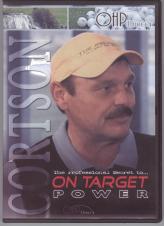
I have read hundreds of golf instruction books dating back from the mid 1800s to the present. Heck, I've written two myself. My video library, I'll stack it up against any one out there. I have tried every conceivable swing method and I am open to any new ideas that come down the pike.
In the 60s through the 90s players swung to the famous reverse "C" position. This made more doctors and chiropractors happy than you can shake a stick at I'm sure. The purpose of that move was to increase centripetal force in hopes of adding power. If timed right you could hit the ball a long way. The down side was if you were the least bit late you hit a wild slice or push. If you flipped your hands in hopes of saving the shot it only made things worse.
I posted earlier about Ben Hogan's "turning point" as it was taught to me by John Schlee. You have to make a lateral move to get your tailbone over your left heel. If you imagine yourself as a door and the hinge runs from your left heel up your spine you just turn your body around that hinge right on through the ball. Couple this along with Hogan's hand action which he stumbled upon you'll be amazed as he was that day he found his "secret".
Hit 'em straight!
Mike
www.benhogan.ws
Thursday, April 1, 2010


Monday, March 8, 2010
Thursday, March 4, 2010
Reverse Views - Ben Hogan & Steve Elkington
REVERSE VIEWS
These photos of Ben Hogan and Steve Elkington dramatically show the amount of lateral shift. I reversed the photos as these mirror images make it easier for a right hand player to emulate. Both players get their centers of gravity over their left heel setting the body in a position like a door hinge around which they can swing.


Copyright 2010 Mike Cortson www.mikecortson.com
Sunday, February 21, 2010
Ben Hogan's "turning point"
Turning Point
Ben Hogan’s turning point (white line below) consisted of him laterally moving his tailbone over his left heel on the downswing. What this did was place his center of gravity over his left foot which set his body in a perfect place where he could then turn hard toward the target. That weight shift, as I describe in my video “On Target Power” , is basically just stepping from your right side to your left and then turning your belt buckle to the target. You are a literally dragging the club through. I feel as if the back of my left hand is slapping the back of the ball. Note that the left shoulder joint is the top of the turning point leading the way through the shot.


Thursday, February 18, 2010
Sunday, January 17, 2010
Monday, January 11, 2010
Too Many Angles
Too Many Angles
The butt end of the club has its own slot during the golf swing. My findings agree with Jimmy Ballard i.e. If you create an angle on the backswing you will have to compensate for it on the downswing in order to get the clubface square at impact. I don’t advocate a rotation of the forearms on the backswing as that motion will create a 90 degree angle leaving the toe of the club pointed skyward as the club shaft is parallel with the target line. In modern teaching once you have the club in this position you simply lift the club over your shoulder as you turn your back to the target.
The problem with this is that at the top of your swing your clubface is 90 degrees open and worse yet, if you’ve cupped your left wrist you’ve opened the clubface even more. All of these things have to be accounted for in the split-second of the downswing. If you throw the clubhead from the top (casting) you have complicated the problem even more by having the clubhead cross the target line leaving you trapped to only be able to deliver the clubhead to the ball from outside to inside the target line. So no wonder you slice.
Even if you don’t throw the club to the outside and simply drop your hands to your side you are still plagued with the clubface being wide open because of the forearm roll and left wrist cupping you've applied on the backswing. So now in that nanosecond you have left you have to violently roll your forearms to account for the angle you created at the start of your backswing and also flip your wrists in hopes of even hitting the ball at all. All of this activity is like trying to choreograph a flock of turkeys on Thanksgiving Day.
So what causes this insanity? It comes from a misunderstanding of how to cock your wrists properly. It has been taught incorrectly forever. Take your left hand and hold it out in front of you palm open and thumb pointed up. Now cock your wrist. Do it very slowly and you will notice that the only way you can accomplish this wrist cock is to rotate your forearm to the right as the back of your left hand becomes visible. There’s the problem. Some call that pronating which is a misuse of the term. The back of your left hand is pointed in the same direction as your clubface. So if you cock your wrist as you are traditionally taught you can readily see that your clubface is opened very wide on the back swing. If you can’t get it closed at impact the clubface is pointed way right (open) and worse yet it has increased your loft dramatically. The high right shot is inevitable.
You are then taught to correct for this to strengthen your grip turning the back of your left hand even more open and getting your right hand now under the shaft in hopes of making it easier to close the clubface. This only creates even more angles and problems. So no wonder golfers suffer so.
Instead of going through all of this wouldn’t it make more sense to be able to use your body as it was built? Learn to create angle that sets up “the angle” which produces the set up to achieve maximum power from the conservation of angular momentum without getting the club opened up that only the most agile and skilled individuals can even come close to repeating it. Simple is better. If you can swing simple and not sacrifice power – even better! The swing I teach is just that. I got it from John Schlee who got it from the master, Ben Hogan. Hogan was one of those skilled and agile people, no doubt. However, you can’t see in his pictures what it was he was feeling and thereby trying to accomplish.
Once I realized how all of this fell together simply, as Hogan did it, did it become repeatable for me. Hogan deliberately disguised what he was doing to keep his edge over his opponents. Schlee showed me this simple “secret” and he said “It’s not in any of the books. If you don’t know what to look for you’ll never find it.” Hogan has been heard to say the same thing. Fewer angles in the wrong places and an angle in the right place makes all the difference.

The butt end of the club has its own slot during the golf swing. My findings agree with Jimmy Ballard i.e. If you create an angle on the backswing you will have to compensate for it on the downswing in order to get the clubface square at impact. I don’t advocate a rotation of the forearms on the backswing as that motion will create a 90 degree angle leaving the toe of the club pointed skyward as the club shaft is parallel with the target line. In modern teaching once you have the club in this position you simply lift the club over your shoulder as you turn your back to the target.
The problem with this is that at the top of your swing your clubface is 90 degrees open and worse yet, if you’ve cupped your left wrist you’ve opened the clubface even more. All of these things have to be accounted for in the split-second of the downswing. If you throw the clubhead from the top (casting) you have complicated the problem even more by having the clubhead cross the target line leaving you trapped to only be able to deliver the clubhead to the ball from outside to inside the target line. So no wonder you slice.
Even if you don’t throw the club to the outside and simply drop your hands to your side you are still plagued with the clubface being wide open because of the forearm roll and left wrist cupping you've applied on the backswing. So now in that nanosecond you have left you have to violently roll your forearms to account for the angle you created at the start of your backswing and also flip your wrists in hopes of even hitting the ball at all. All of this activity is like trying to choreograph a flock of turkeys on Thanksgiving Day.
So what causes this insanity? It comes from a misunderstanding of how to cock your wrists properly. It has been taught incorrectly forever. Take your left hand and hold it out in front of you palm open and thumb pointed up. Now cock your wrist. Do it very slowly and you will notice that the only way you can accomplish this wrist cock is to rotate your forearm to the right as the back of your left hand becomes visible. There’s the problem. Some call that pronating which is a misuse of the term. The back of your left hand is pointed in the same direction as your clubface. So if you cock your wrist as you are traditionally taught you can readily see that your clubface is opened very wide on the back swing. If you can’t get it closed at impact the clubface is pointed way right (open) and worse yet it has increased your loft dramatically. The high right shot is inevitable.
You are then taught to correct for this to strengthen your grip turning the back of your left hand even more open and getting your right hand now under the shaft in hopes of making it easier to close the clubface. This only creates even more angles and problems. So no wonder golfers suffer so.
Instead of going through all of this wouldn’t it make more sense to be able to use your body as it was built? Learn to create angle that sets up “the angle” which produces the set up to achieve maximum power from the conservation of angular momentum without getting the club opened up that only the most agile and skilled individuals can even come close to repeating it. Simple is better. If you can swing simple and not sacrifice power – even better! The swing I teach is just that. I got it from John Schlee who got it from the master, Ben Hogan. Hogan was one of those skilled and agile people, no doubt. However, you can’t see in his pictures what it was he was feeling and thereby trying to accomplish.
Once I realized how all of this fell together simply, as Hogan did it, did it become repeatable for me. Hogan deliberately disguised what he was doing to keep his edge over his opponents. Schlee showed me this simple “secret” and he said “It’s not in any of the books. If you don’t know what to look for you’ll never find it.” Hogan has been heard to say the same thing. Fewer angles in the wrong places and an angle in the right place makes all the difference.

Subscribe to:
Posts (Atom)


